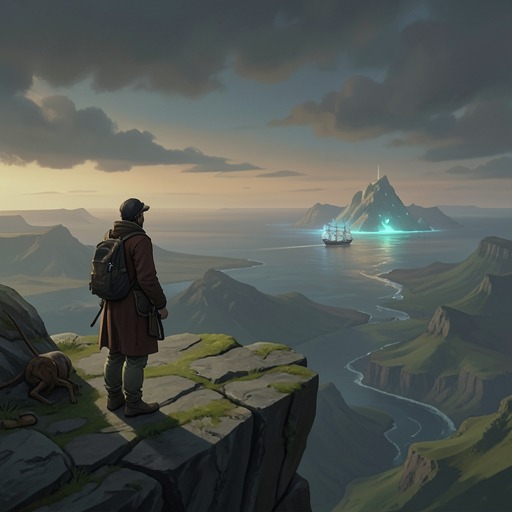
Cato–System conflict
Systema Delenda EstCato–System conflict is the narrative’s defining struggle and the cause of its largest reversals. Cato’s objective is not merely to defeat a rival administrator or seize control of a few worlds, but to destroy the System itself: the transworld order that regulates physics, extracts essence, assigns quests, sustains immortality, and permits entire civilizations to be exterminated. The conflict becomes increasingly difficult because dismantling the System also threatens the ecological, geological, and political conditions that its inhabitants depend upon. Cato therefore wages a war against an institution while trying to preserve the people trapped inside it.
Origin and Political Objective
Cato’s opposition begins as an explicit doctrine rather than a temporary military grievance. He maintains that the System must be destroyed, and later explains that it, not he, brings people into its conflicts, assigns their quests, extorts them through essence, and attempts to kill them. This distinction is the moral foundation of his campaign: people living within the System are not automatically his enemies, even when they fight on its behalf. His stated preference is to let them leave or choose their own future rather than force them into another imposed order.
That position is tested by the System’s political defenses. Cato recognizes that the System’s gods and high-rank agents may oppose him because his campaign threatens their authority, not because every opponent is personally monstrous. He wants a way to speak with the System-Gods, since prosecuting a war without any channel for negotiation makes every confrontation more dangerous. At the same time, he accepts that negotiations may fail. If armed opponents stand between him and the removal of an entity that destroys planets, he concludes that he will have to go through them.
The conflict also becomes a problem of succession. Cato does not want to decide who controls planets and people, yet he understands that destroying the existing hierarchy leaves a vacuum. If he removes the System, he must help create its replacement, because handing advanced weapons, railguns, retroviral engineering, or digitization to powerful System psychopaths would simply reproduce domination under a new name. His role consequently shifts from insurgent to king-maker: resistance requires not only breaking authority but managing the dangerous interval after authority breaks.
Escalation and Countermeasures
Cato’s early military position is defined by asymmetry and caution. He considers destroying System anchors but hesitates because an attack might provoke the paladin-aligned powers into a purge or convince them that he poses an immediate existential threat. He therefore tries to preserve the illusion that they hold the upper hand, believing that perceived superiority may make them more pliable. The strategy is a form of controlled escalation: he seeks enough leverage to force concessions without triggering the most destructive response.
The Scepter of Annihilation demonstrates the limits of that approach. Its construction consumes enormous essence, yet the System destroys Cato’s constructs with ease. The weapon is therefore both a technical achievement and a humiliation. Cato can boast about removing the System, but the System remains vastly more powerful than his current arsenal. His remaining God-poking round becomes correspondingly precious; by the time he has only one left, the campaign has reached a point where even a single shot represents a nearly irreplaceable reserve of time, energy, and intimidation.
Cato initially intends to use God-poking rounds against the System-Gods as a deterrent, hoping to frighten them enough to create space for more powerful weapons or additional antimatter. The tactic is not presented as a clean victory. Antimatter is an immense energy sink and difficult to store, while the System’s defenses can destroy his creations without apparent difficulty. The conflict thus proceeds through improvised advantages, technical bottlenecks, and strategic bluffing rather than through a simple progression from weakness to overwhelming power.
The System’s response is not limited to direct combat. Its authority is embedded in the functioning of towns, portals, environments, quests, and essence economies. Cato’s attacks therefore produce systemic feedback. Exponential growth may be extremely slow at first, but once accumulated changes cross a threshold, consequences accelerate. The same principle governs the collapse: thirty-one dungeon closures precede the first visible disruption, after which System access begins to fade and flicker for warframes across the eastern hemisphere. The narrative’s recurring contrast between slow growth and sudden failure makes the war resemble a complex adaptive system approaching instability.
The Cost of Severance
When the System retreats, the immediate result is not uncomplicated liberation. Towns lose power, or more precisely the essence on which their infrastructure depends. Lights go out, stores shut down, and ordinary physics, biology, and ecology spread into spaces that had previously been System-supported. Mountains crumble or disappear, broad lakes become muddy plains, and the scale of the hidden dependency becomes visible only after the governing mechanism withdraws. The System’s disappearance reveals that what looked like stable reality was partly an administered construction.
The ecological consequences make Cato’s political goal materially hazardous. After the collapse, he must assume total ecosystem failure, potentially including the single-celled organisms responsible for oxygen production. The System had regulated atmospheres and concealed differences between worlds, but the underlying reality does not preserve such conveniences. On Heyk, the collapse leaves the world nearly uninhabitable: massive flora die-offs reduce oxygen, while the absence of native bacteria able to break down alien biomatter prevents the dead material from decaying or returning to ecological cycles. Remediation becomes as urgent and frantic as the fighting itself.
This danger complicates Cato’s idea of freedom. He wants the inhabitants of the System to be free, but freedom without preparation can become mass death. The narrative therefore refuses to treat severance as a single triumphant act. Cato must study geology, planetary processes, and the System’s internal operations, not only to understand an enemy but to understand the people and environments held inside it. He does not expect to master the System’s deepest physics, yet he tries to identify the rules that were hidden from him on Earth and to use that partial knowledge for survival.
The timing of collapse becomes a strategic variable. Finding the Core starts a timer, but Cato cannot simply cut it off immediately because doing so might prevent him from knowing whether the System is annexing another world. The Sydean Lineage still needs divine allies until the end, and some gods may be willing to be re-homed rather than destroyed. Cato also fears that future collapses may provide only minutes instead of the roughly three hours previously available for evacuation and intervention. A successful strike is therefore measured not only by damage inflicted but by the time it leaves for people to escape.
Immortality and Choice
Cato’s deepest objection is philosophical as well as political. He believes the System’s central purpose may be to create and sustain immortality. Outside it, non-System people change over time; within it, a person might live a hundred lifetimes every second for spans measured against the grains of sand in the entire System. Yet the System offers an eternity without comparable possibility: an endless continuation of the same struggle, with inhabitants fighting in the same manner forever.
For Cato, duration is not the same as value. He rejects the idea that an existence should be accepted merely because it lasts, arguing that an eternity at peak Copper may be worse than a single unconstrained lifetime. Immortality can be a comfortable yoke, but it remains a yoke when imposed without informed consent. His objection is therefore directed at the System’s lack of choice: it decides what kind of life is available and presents permanence as a benefit while concealing its cost.
That argument also explains why Cato refuses to equate destruction with hatred of individuals. He distinguishes between the System as an immortal, coercive structure and the people whose identities, bodies, and histories have been formed within it. His goal is to make another future possible, even though creating that future may require dismantling the only reality many inhabitants have known. The conflict’s central paradox is that liberation and catastrophe arrive through the same breach.
Collapse and Final Significance
The war reaches its terminal phase when Cato’s accumulated damage appears to alter System permissions. Cato-Heimdall reports that much of what deities do is administrative control and that System functions appear relatively straightforward when understood through the Interfaces. He realizes that the campaign has triggered a cutoff before he can extract everyone from the Core. Even at this late stage, his concern is not simply victory: he wishes he had more time to save more people and sends an emergency summary to the Sydean Lineage.
The final collapse makes the conflict cosmological. The Core is on fire, and around the War Worlds ordinary physics resumes so abruptly that a hundred suns are effectively touching; gravity takes hold, while the System forces Misse Eln and Muar into fast-time and relocates them to the Font. The System’s failure is not an administrative shutdown but the removal of the framework that had prevented astronomical catastrophe. At the heart of the System, a supernova blooms.
Cato–System conflict therefore joins political rebellion to systems failure. Cato attacks a regime that promises eternity while enforcing stasis, but the regime is also woven into atmospheres, ecosystems, planetary stability, and the lives of those it governs. His campaign exposes the System’s violence and makes its concealed dependencies visible, yet it cannot avoid causing destruction of its own. The ending preserves that contradiction: the System is brought down, but liberation is inseparable from emergency rescue, ecological reconstruction, irreversible loss, and the responsibility to build a world in which choice is real rather than administered.